In the first half of the 20th century, an economic depression, two world wars, waves of communist revolutions in Eastern Europe, the rise of fascism and dictatorship in Germany, Italy and Spain, and ultimately the beginning of the Nuclear Age left the population of Europe polarised and anxious. What sounds like a dystopian novel itself was the reality for millions of Europeans and can be linked to explain the decreasing prominence of the church as a bearer of morality and security for people, a trend that was also picked up by prominent writers at the time. The most popular and widely read dystopian fiction novels shaped by current world affairs are Aldous Huxley’s Brave New World (1932) and George Orwell’s Nineteen Eighty-Four (1949). Both novels portray dystopian worlds, determined either by consumerism and pleasure or a totalitarian government, in which religion as we know it seems absent. Do these books suggest that a state without religion is ultimately dystopian? Upon closer consideration, the opposite can be discerned. In the following essay, I will give an insight into the history of secularisation in Western societies. Afterwards, by looking at both Huxley’s and Orwell’s novels, I will argue that both authors did not abolish religion in their view of the future, as they merely transferred religious sentiment, making religiosity a determining factor in the dystopianism of the texts. While religiousness in Huxley’s world is directed towards consumerism, rendering God obsolete, Orwell satirises the church in the Party of Big Brother and questions the power of institutional religion over society.
To analyse the portrayal of institutional religion and spirituality in the dystopian texts mentioned above, it is essential to consider the process of secularisation that happened in the Western world during the formative stages of its modernisation and before the publication of the texts. In his book on the secularisation of modern society, Alan D. Gilbert notes the importance of the fact that “elements of modern secular consciousness existed already, at least in embryo, in the literature, philosophy and art of Hellenic and Roman civilisation” (18). The reason why this is often overlooked can be linked to the suppression and eradication of secularising tendencies from the ancient world in the Middle Ages. The establishment of a “congruity […] between Christian theology and the dominant beliefs and values of the wider society” led to a “re-enchantment” of Europe (19). Consequently, the church held the power to stop any forms of scientific progress or nonclerical thinking, deeming it blasphemous to explain the world in terms that did not fit the Christian consensus.
With the beginning of the Renaissance period in Italy, Gilbert states that “Europeans began to examine their contemporary culture in terms increasingly critical, and to seek its enrichment through philosophical systems and intellectual perspectives salvaged from a classical world” (20). The emerging philosophy of humanism led to a growing valuing of the individual and self-expression, a mentality that opposed that of medieval culture. The Christian consensus prevailed but was not invincible anymore, leading to an increase in criticism of “ecclesiastical forms and clerical abuses” (Gilbert 21). As science emerged as a new European cultural activity that slowly began to explain human experiences, the supernatural and “magico-religious” interpretations were replaced (Gilbert 23). After the Reformation, another important step towards a secularised and modern world was introduced with the Enlightenment, breaking “the basic Christian consensus which the Reformation crisis had left fragile” (34). Once the faith in human reason emerged, it was inconceivable to go back to the religiousness of the medieval world.
The secularist tendencies Gilbert describes are mirrored in Steve Bruce’s study on religion in modern Britain, in which he claims that from the Reformation to 1900, the nature of Christian religion in Britain changed fundamentally, with consequences for its relations to the individual. As a result, we can discern a shift in the relationship between the religious and their belief. According to Bruce, religion was no longer about “glorifying God but about personal growth” (17). With economic modernisation came “cultural pluralism, egalitarianism, and individualism”, making the church’s form of religion “untenable” (Bruce 27). Interestingly, these trends of secularisation and a change in the religiousness of the individual can be observed when looking at Huxley’s Brave New World and Orwell’s Nineteen Eighty-Four. At first glance, both novels suggest incompatibility with the dystopian state order and religion. However, upon closer analysis, it can be discerned that religiosity still exists and turns out to contribute to the dystopianism of the texts.
In his essay, Milton Birnbaum evaluates Aldous Huxley’s stance on religion and his search for values in spirituality. When looking at his most famous dystopian novel, Brave New World, it seems like Huxley’s quest was unfruitful. Churches do not exist anymore, God has become obsolete, and humanity is preoccupied with work, entertainment, and pleasure in form of sex and drugs. Nevertheless, the first impression of a human race that has loosened its ties to god is distorted in the course of the novel.
The futuristic world Huxley creates displays an advanced society that has reached ultimate happiness through its freeing from religion and dependence on a godlike figure. Birnbaum states that Huxley blamed religion “for making people believe that this world is but a gloomy interlude between earthly pain and celestial euphoria” (171). Interestingly, this viewpoint is mirrored in the character of the Controller, Mustapha Mond, who sacrificed religion to reach happiness. Mustapha’s thinking extends the concept of secularisation as he suggests that happiness and religion are incompatible: “God isn’t compatible with machinery and scientific medicine and universal happiness” (207). Similarly, Huxley believed that Christianity comes upon a happy person and “then it reminds him that this state of well-being is but illusory and certainly temporary” (Birnbaum 172). Huxley believed that religiousness turns life for the individual into a sort of in-between state, in which happiness is unobtainable. To overcome this and reach happiness, humanity has to be independent of God through “youth and prosperity”, according to Mustapha (206). In his world, people do not grow old, but they engage in a consumerist society and distract themselves with plentiful offers of modes of entertainment and sexual partners. This surplus of “youthful desires” renders the belief in God obsolete (206). The fact that humankind has liberated itself from God and can create happiness for itself suggests its independence and progress and explains why Mustapha believes humanity to be at its peak. It seems like the world Huxley imagines takes up the process of secularisation and continues it up to a point at which humanity not only distances itself from institutional religion but turns away from a godlike figure.
Nonetheless, upon closer analysis of the world in Huxley’s dystopian novel, it is made apparent that mankind’s independence is a lie, and religiosity still determines their lives. Instead of eradicating religion, God is merely substituted, and the religious sentiments are directed towards consumerism in the so-called Solidarity Services and the drug soma, which are described as “Christianity without tears” (210). In his essay, Brad Congdon notes that “[c]apitalism exists not to satisfy the demands of the economy but, instead, the individual religious emotion” (97). The state of happiness that humanity has reached, according to Mustapha, is dependent on notions of consumerism as “[h]appiness has got to be paid for” (201). Humankind has not freed itself from God but created a new God in “[o]ur Ford”, alluding to Henry Ford, who inspired a system of mass production known as the economic theory of Fordism (27). At the Solidarity Services, participants make the “sign of the T”, representing Ford’s famous Model T automobile (69). The replacement of the sign of the cross with a symbol alluding to a consumer good reveals a practice of worshipping materialism in society. In Huxley’s dystopia, consumerism has surpassed the status of religion, positioning Ford as a godlike figure, and making society worship their new god by partaking in consumer culture.
Moreover, the language Huxley uses to describe the drug soma and the Solidarity Service, celebrated by Bernhard Marx and his fellow community members, is determined by religious images. A “choir” singing the “First Solidarity Hymn” suggest that humankind may not attend masses as we know them but has found alternative ways to hold communal services and celebrate their faith (70). During the service, the practitioners experience the coming of the “Greater Being” leading to a climactic end of the mass (72). As Congdon argues, the “Solidarity Service is a perfect religious experience satisfying the religious emotion” (97). In addition to that, mankind is dependent on taking soma, which is passed on like the communion during service and enables them to reach a state of “lunar eternity” (122). The fact that mankind drowns its religious feelings in the need to consume and by taking soma and attending mass-like events like the Solidarity Service proves that humanity is, after all, not independent but merely shifted its religious sentiments. Interestingly, the persistence of human religiosity suggests that it may be superfluous, but it is natural and cannot be cast off even in a dystopian environment.
In his essay on George Orwell and his religious opinions, John Rodden states that “Orwell saw Catholicism as intellectually fashionable, hierarchically structured, and conservative or even fascist in political influence” (46). In Nineteen Eighty-Four, Orwell creates a totalitarian state led by the Party, which shows parallels to the Third Reich in Germany or the Francoist dictatorship in Spain. In the forefront of the government in Nineteen Eighty-Four stands Big Brother, an untouchable, almost mythical figure, promising to annihilate all opposition to control the population of Oceania. Although the Party does not allow its people to believe in anything other than its doctrines and Big Brother, it seems like religious sentiment is not completely extinguished.
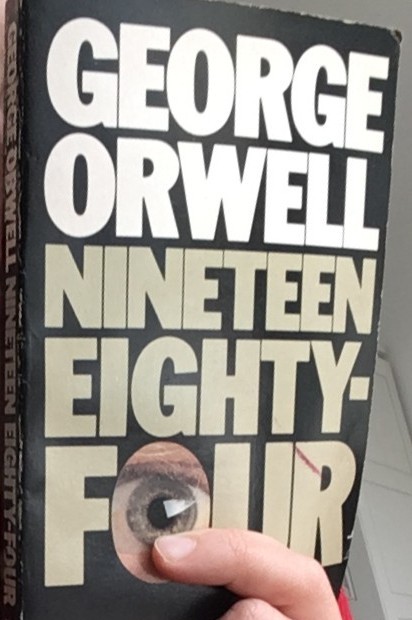
In Orwell’s idea of the future, religion and the church have been eradicated in the eyes of a totalitarian state that does not allow any form of distraction from the Party. On his quest to rebel, Winston Smith learns about the churches that are now in ruins. When discovering the “disguised and forgotten” churches, Winston remembers he “never in real life heard church bells ringing”, indicating that religion and its institutions are part of the antecedents (89). The remains of the churches suggest that religion was once an important part of human life, representing communal religiousness, but it has been stripped of its symbolism. Ultimately, in Oceania, all “beliefs, habits, tastes, emotions, mental attitudes […] are really designed to sustain the mystique of the Party” (180). Not only do the ruined churches symbolise the extinction of the religion, but so does the imprisonment of Winston’s friend Ampleforth, who did not erase the word “God” from a poem he censored at work (199). Consequently, the people of Oceania are living in a “post-Christian” world, as Patricia Hill puts it in her essay on religion in Nineteen Eighty-Four (273). The fact that the Party and Big Brother have complete control over the people and decide upon their education, opinions, and beliefs leads to the elimination of any exercise of religion.
Upon closer examination, however, it is made apparent that religiosity has not left humankind but has been redirected towards the Party and its omnipotent leader, Big Brother. In the course of the novel, Big Brother is repeatedly portrayed as a godlike figure, “an invincible, fearless protector” (17). During the daily “Two Minutes Hate” sessions, which show similarities to Huxley’s Solidarity Services in their communality, climactic ecstasy and mass-like structure, the participants engage in singing and praying for Big Brother (19). Consequently, the ritual is meant to speak to the “wisdom and majesty of Big Brother”, alleviating him from his supporters and drawing parallels to a mass celebrating the power of a god (19). Hill adds to this idea by stating that “there is room for only one god in Oceania, and his name is Big Brother” (273). The language used to describe the “infallible and all-powerful” Big Brother, who acts as a “focusing point for love, fear, and reverence”, mirrors the language religions like Christianity use to outline god (179). In Nineteen Eighty-Four, religiosity is used to position Big Brother as a supernatural being worshipped by all of society.
As Winston learns about the pyramidal structure of Oceanic society, the parallels between the state of Big Brother and the institutional church are laid out. After Big Brother follows the Inner Party, representing the institution of the church, and the Outer Party, standing for the religious members. Interestingly, the people who do not belong to the Party are described as the “dumb masses” due to their status as outsiders, which recalls Gilbert’s outline of the church in the Medieval world (179). Before the Enlightenment period, the church did not accept beliefs and values differing from the Christian consensus and a non-Christian was seen as “an ideological deviant”, reminding of Nineteen Eighty-Four (Gilbert 34). Winston himself experiences that ideological deviants are not accepted and undergoes reconditioning in the Ministry of Love, which “invites comparison with the Inquisition” according to Hill (274). After months of torture and reeducation, Winston’s religiousness is resuscitated, and he is made to internalise that “God is Power” (227). Discerning the power of religion over people, the Party uses religious structures to manifest its position. The fact that the novel ends with Winston ultimately loving his god, Big Brother, indicates that religion has never left Oceania, as it was merely redirected according to the doctrine of the state to ensure the population is following the Party. Consequently, Nineteen Eighty-Four can be read as a satire of the institutional church as Orwell raises awareness of the dangers of an unconditional belief system, whose values and doctrines a determined by a sole and powerful institution. The redirected use of religion determines the dystopianism of Orwell’s novel, showing that religion is not absent in his view of the bleak future, but controls it.
As the short outline of the history of western secularisation suggested, in a modernised world, the status of the institutional church and religion has changed. In the West, a highly individualised and capitalistic society, it seems like humankind does not necessarily rely on religious institutions anymore to receive a set of values and morals to believe in. Moreover, at the time Huxley and Orwell were writing their dystopian novels, Christianity was criticised for supporting fascist governments like that of Francisco Franco in Spain, for example. According to Hill, Orwell’s novel “warns us of the ease with which a modern myth, racial or economic, can be institutionalised into a state religion more powerful and oppressive than any church of previous eras” (277). His satire, therefore, becomes a warning of the dangers of a power monopoly, suggesting that the sole belief in a certain mythical power and its followers can turn into a wholly dystopian concept. Huxley, too, acknowledges the changing dynamics of humanity’s relationship with religion. In the dystopian world he creates, it seems like there is no place for institutional religion as it creates a sort of dependency on humans and their beliefs. Nevertheless, the novel reveals that in a consumerist world, religiousness has not left mankind but is redirected towards materialistic gain, pleasures, and drugged distractions.
To conclude, Orwell shows that the unconditional belief in a totalitarian state, using religious attributes to manifest its position, is a dystopian idea, while Huxley explores a world in which institutional religion is absent, although it does not stop humankind’s will to display spiritual sentiment towards their idea of fulfilment. Therefore, religiosity plays an important part in both novels and ultimately influences our understanding of the dystopia of the texts, which could mean the total control of institutional religion over society or its absence. A trend of growing secularisation and modernisation was an aspect that features in Orwell and Huxley’s novels, but both authors seem to suggest that religiousness towards a purposeful transcendence is a natural concept to humankind and will never be cast off, even in a dystopian-looking future.
Questions of religion, materialism, totalitarianism, state control, technological advancement and so forth have probably never been more relevant than today, in the year 2025. I wrote this essay back in 2020, not knowing that 5 years later I would reread it and feel astonished by how relevant it still is. What happens when we stop questioning politics, information services, and ourselves? What happens when we start worshipping material goods and technological devices by expecting utter fulfilment from them? Novels like 1984 and Brave New World are books that should never leave our canon, not because they are flawless or perfect or because their authors were, but because they teach us to think critically and question everything we know.
Bibliography:
- Birnbaum, Milton. “Aldous Huxley’s Quest for Values: A Study in Religious Syncretism.” Comparative Literature Studies, vol. 3, no. 2, 1966, pp. 169-182.
- Bruce, Steve. “The Past.” In Religion in Modern Britain, Oxford University Press, 1995, pp. 1-29.
- Congdon, Brad. “Community, Identity, Stability”: The Scientific Society and the Future of Religion in Aldous Huxley’s Brave New World.” ESC: English Studies in Canada, vol. 37, no. 3, 2011, pp. 83-105.
- Gilbert, Alan D. “Secularization and western culture.” In The Making of Post-Christian Britain: A history of the secularization of modern society, Longman Group Limited, 1980, pp. 17-40.
- Hill, Patricia. “Religion and Myth in Orwell’s 1984.” Social Theory and Practice, vol. 10, no. 3, 1984, pp. 273-287.
- Huxley, Aldous. Brave New World. Vintage, 2007.
- Orwell, George. Nineteen Eighty-Four. Penguin Books, 1983.
- Rodden, John. “Orwell on Religion: The Catholic and Jewish Questions.” College Literature, vol. 11, no. 1, 1984, pp. 44-58.
- Roelofs, Mark H. “George Orwell’s Obscured Utopia.” Religion & Literature, vol. 19, no. 2, 1987, pp. 11-33.
- Woiak, Joanne. “Designing a Brave New World: Eugenics, Politics, and Fiction.” The Public Historian, vol. 29, no. 3, 2007, pp. 105-129.

 reading classics